

Prerequisites
Before creating an automation, make sure you have the following ready based on your trigger type:- For list/segment triggers: Create a contact list or segment that represents your trigger condition.
- For property-based triggers: Ensure your contacts have the relevant contact properties set up. The automation will evaluate these properties to determine when to trigger.
How to Create an Email Automation
Create Your Automation
Under Marketing Emails in the sidebar, select Automations and click New Automation.An untitled automation will be created. Give it a descriptive name that clearly identifies its purpose, such as “Pro Plan Onboarding” or “Welcome Series.”
Set Your Trigger
Click on the Trigger card to configure what starts your automation. AutoSend offers four trigger types: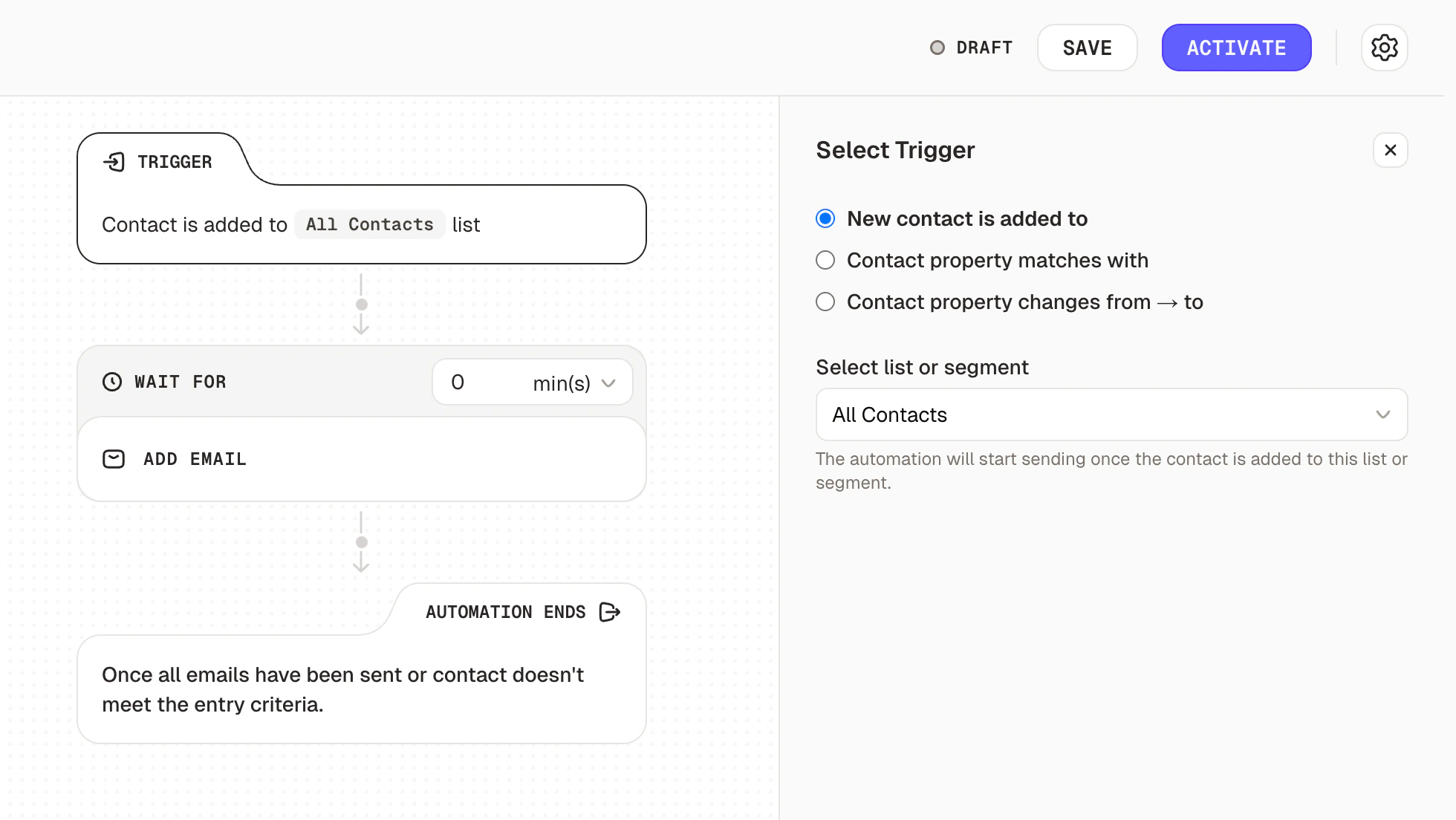
New contact is added to
Select a contact list or segment. When a contact joins this list or segment, they automatically enter the automation.Example: Create a segment called “Pro Plan Members” with the contact propertyplan: pro. When a user purchases a Pro plan and enters this segment, the automation triggers.Contact property matches with
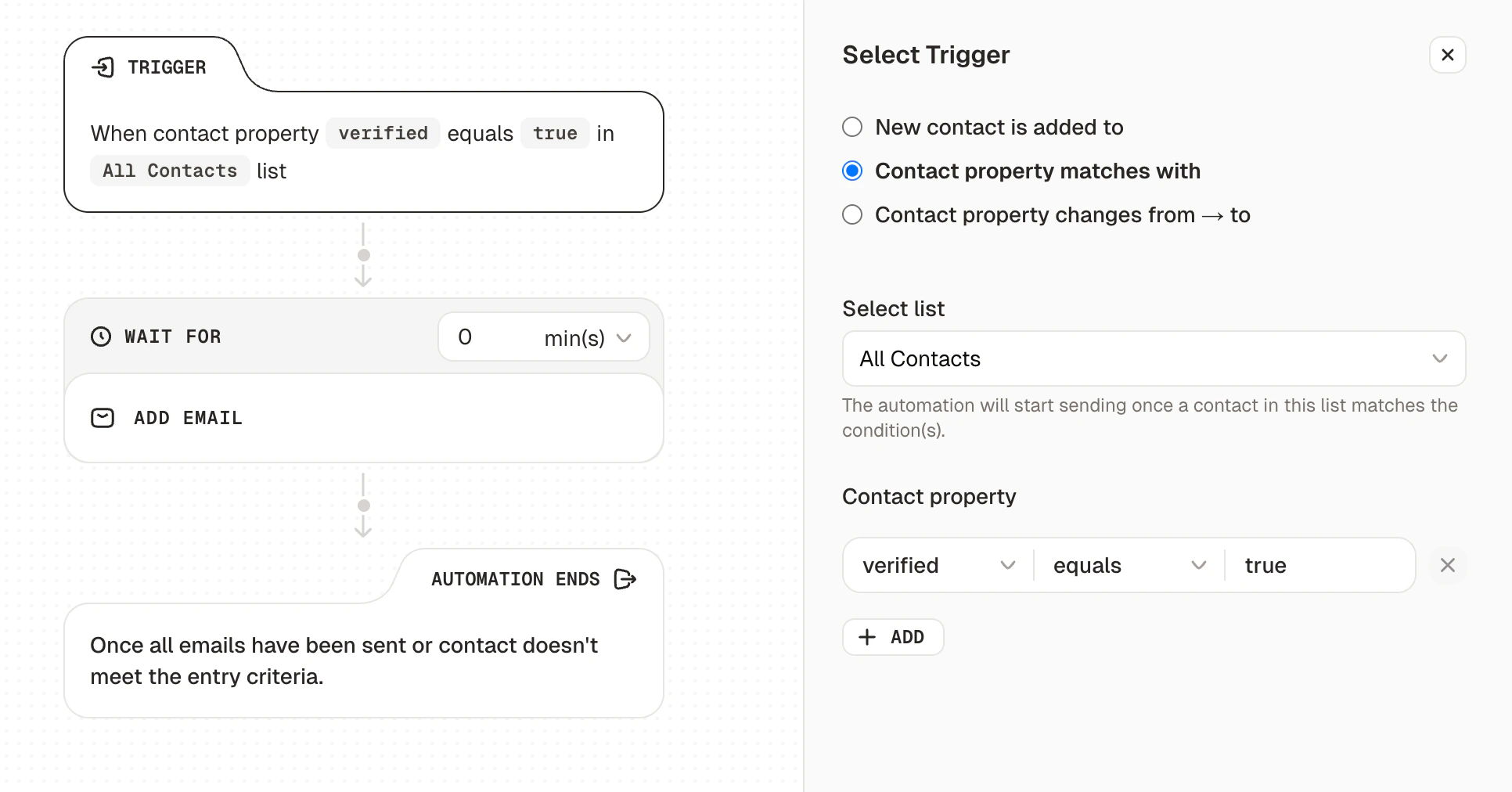
Select a list to scope the contacts, then define a property condition. The automation triggers when a contact in that list matches your condition(s).- Choose a contact property from the dropdown (e.g.,
verified) - Select an operator (e.g.,
equals) - Enter the value to match (e.g.,
true) - Click Add to include additional conditions if needed
verified equals true on the “All Contacts” list. Any contact whose verified property becomes true will enter the automation.Contact property changes from → to
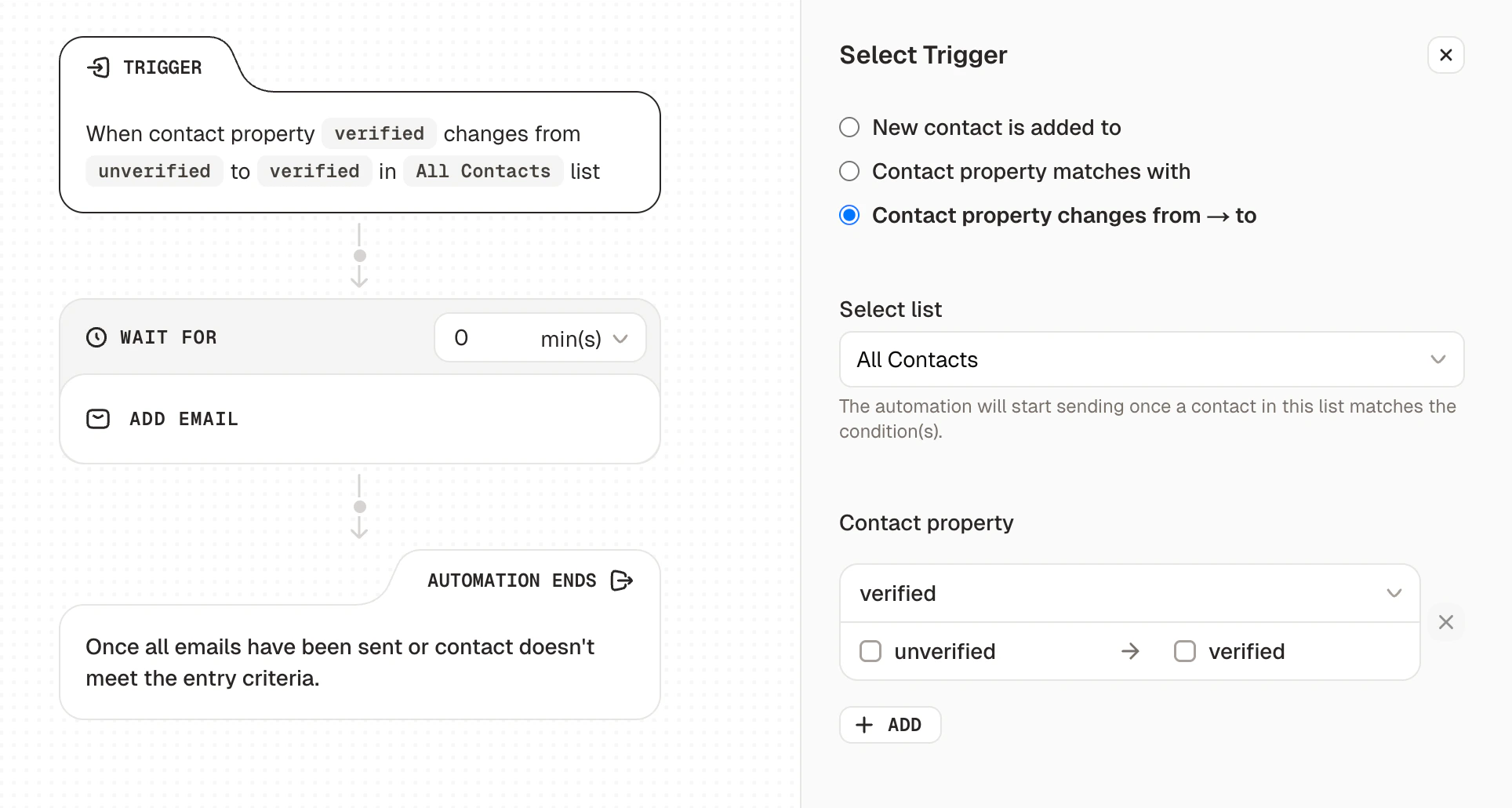
Select a list to scope the contacts, then define one or more property transitions. The automation triggers when a contact’s property changes from one specific value to another.- Choose a contact property from the dropdown (e.g.,
published) - Set the from value (e.g.,
unpublished) and to value (e.g.,published) - Click Add to include additional property change conditions
- Use AND / OR logic to combine multiple conditions
published changes from unpublished to published in the “All Contacts” list. Perfect for sending a congratulatory email when a user publishes their first project.Event Received
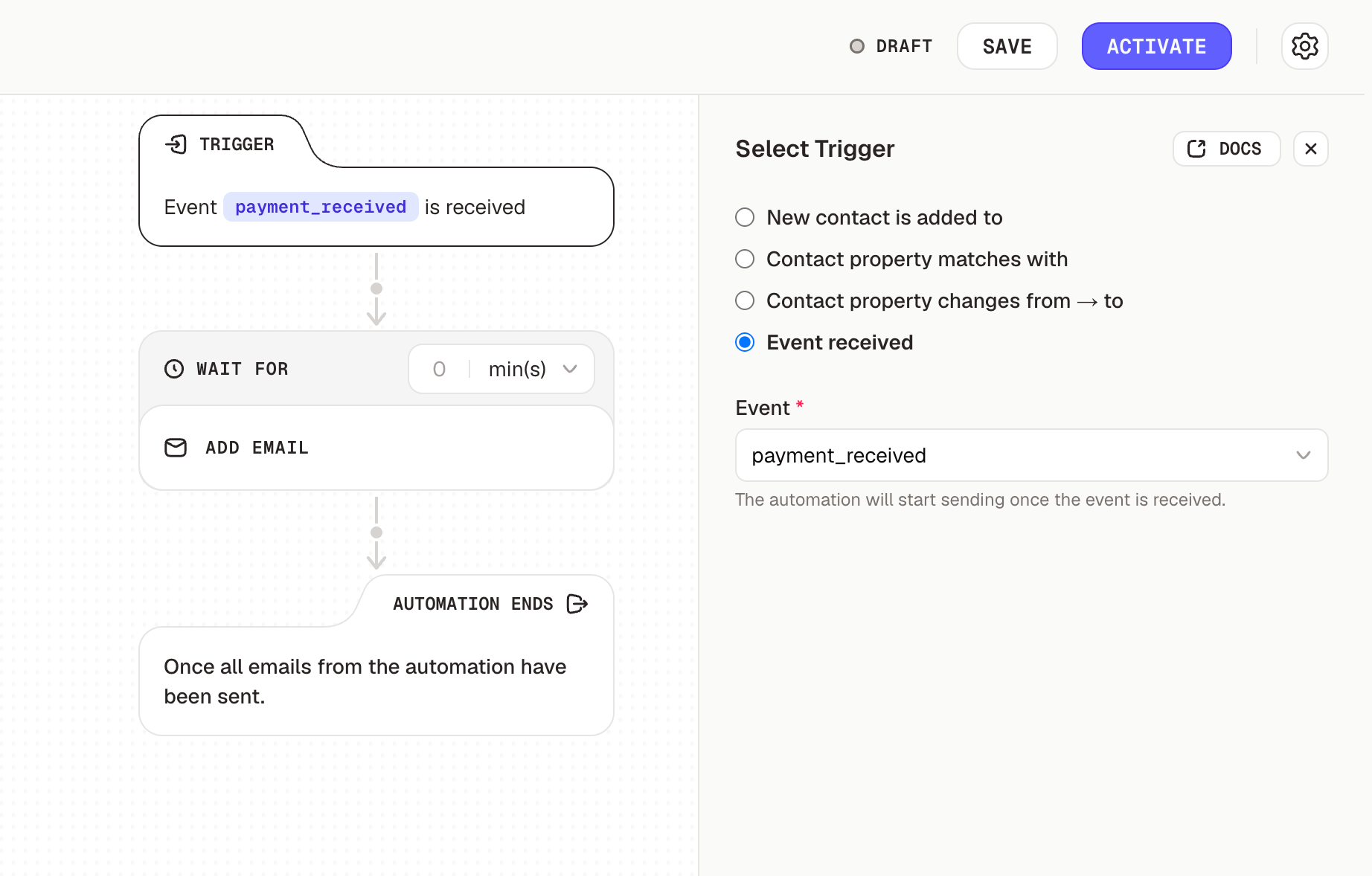
Pick a custom event from the Event dropdown. The automation triggers whenever that event is recorded for a contact, using the data carried in the event payload.Unlike the other trigger types, Event Received is not scoped to a list or segment. Any contact for whom the event fires enters the automation.- Select Event Received as the trigger type
- Choose an event from the Event dropdown (lists every event defined in this project)
- Save the trigger
order_completed is received. Then use a branch on the event’s order_total property to send different post-purchase sequences for small vs. large orders.Only events received after the automation is activated will trigger it. Historical events are not replayed. Don’t have an event yet? See Events to define one.
Add Emails to Your Automation
- Click Add Email to create your first email in the sequence
- Set the Wait For timing to determine when this email should be sent:
- By default, the timing is set to 0 seconds (immediately)
- Adjust the timing based on your email strategy (e.g., 30 mins, 6 hours, 3 days)
- Design your email content, subject line, and preview text and select the sender
- Repeat to add more emails to your sequence
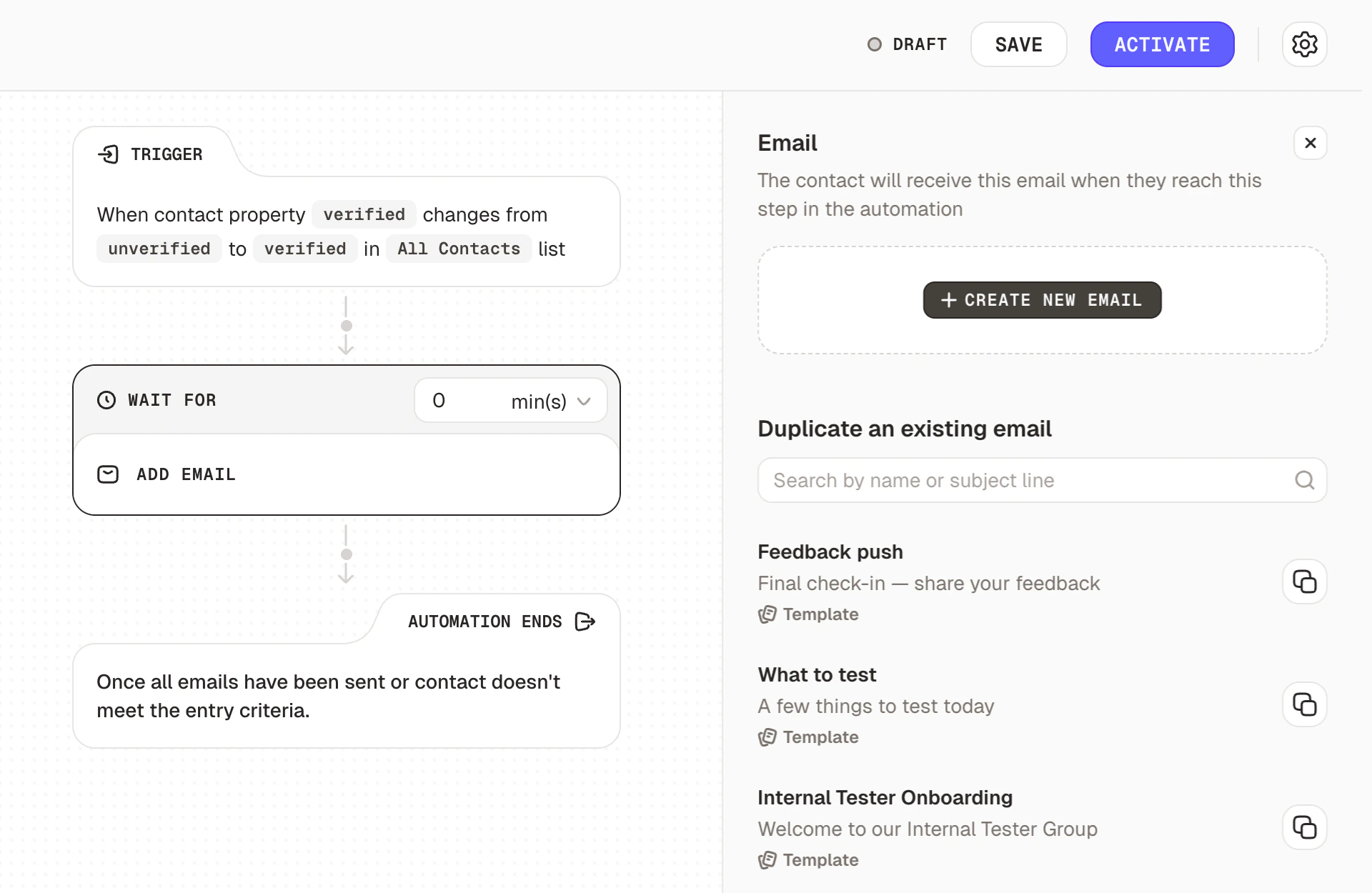
You can add up to 10 emails in a single automation. Plan your sequence thoughtfully to deliver value without overwhelming your contacts.
Automation Settings
Configure the following settings for your automation: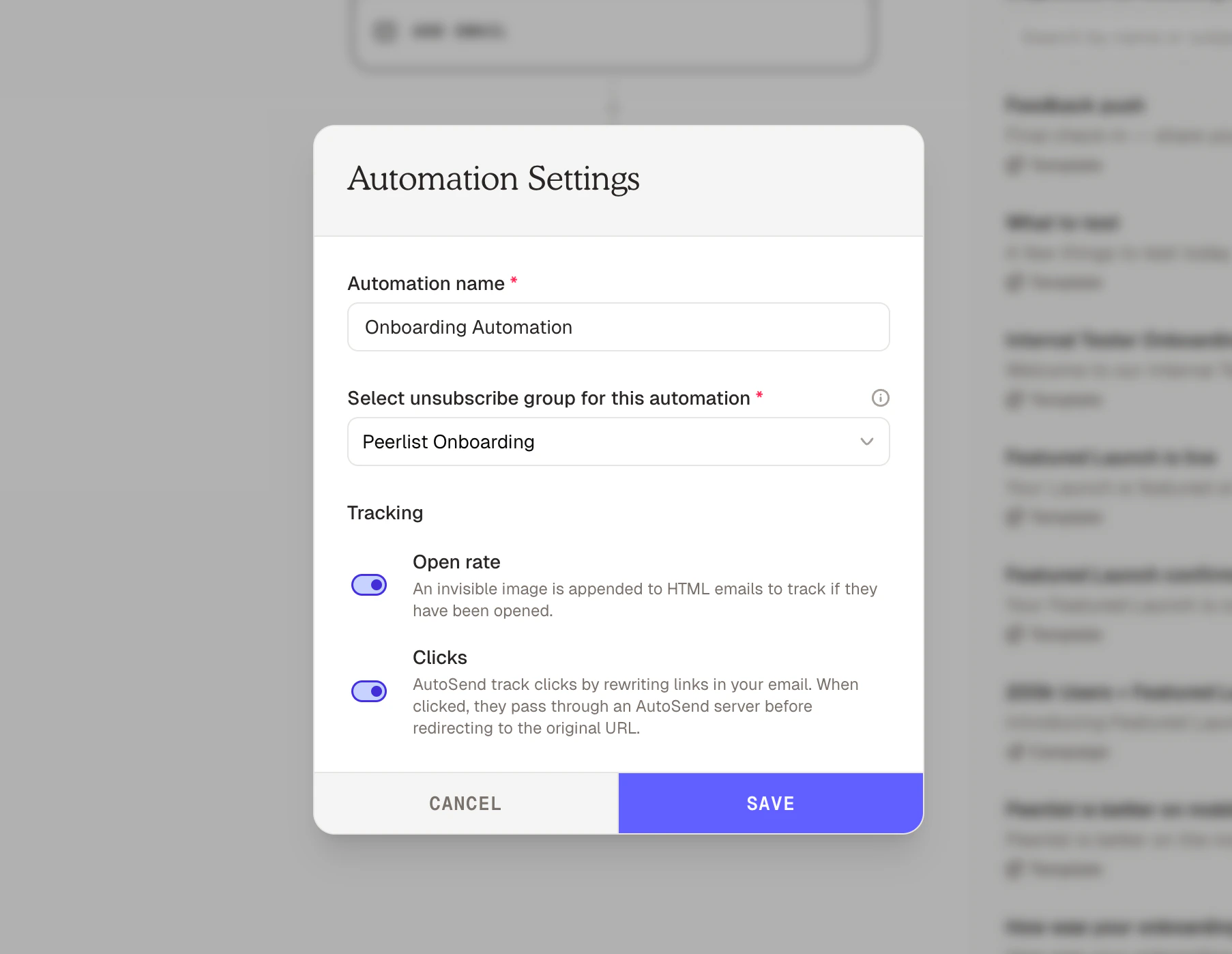
- Automation name: Give your automation a descriptive name (e.g., “Onboarding Automation”).
- Unsubscribe group: Select an appropriate unsubscribe group. Automations are treated as marketing emails and are required to include an unsubscribe link for compliance with email regulations.
- Tracking: Toggle tracking for:
- Open rate: An invisible image is appended to HTML emails to track if they have been opened.
- Clicks: AutoSend tracks clicks by rewriting links in your email. When clicked, they pass through an AutoSend server before redirecting to the original URL.
Activate Your Automation
Once you’ve configured all settings and added your emails: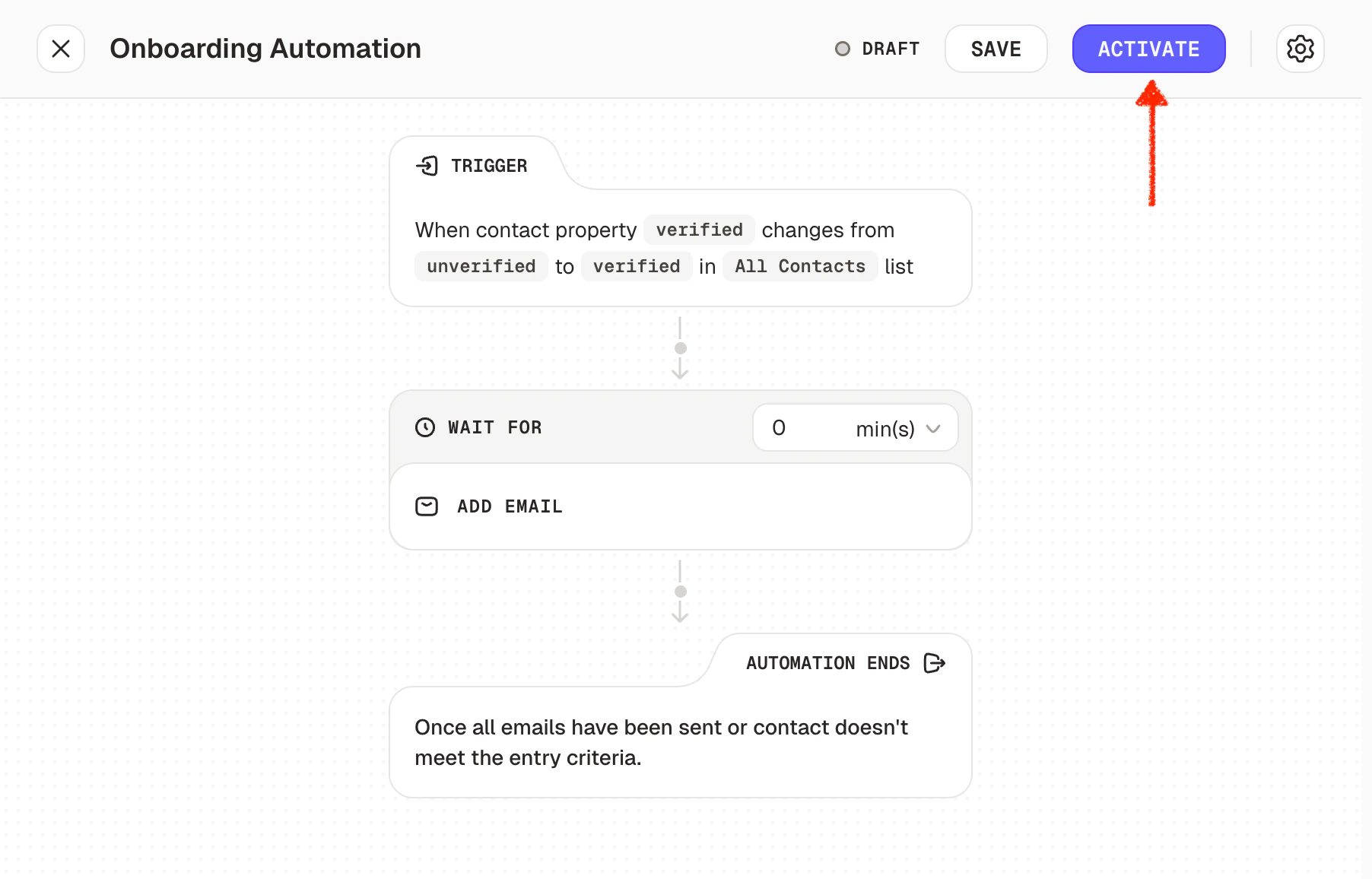
- Review your automation flow to ensure everything is correct
- Send test emails to verify content and personalization
- Click Activate to make your automation live
Troubleshooting
Contacts aren't entering my automation
Contacts aren't entering my automation
- Verify the automation is in Active state, not Draft or Paused.
- Check that contacts are actually joining your trigger list or segment.
- Ensure your list or segment criteria are correctly configured.
- For property-based triggers, confirm the contact property exists and has the expected values.
- Contacts uploaded via CSV won’t trigger automations. Only contacts updated/added via API or from the dashboard will be enrolled in automations.
Property-based trigger isn't firing
Property-based trigger isn't firing
- Verify the contact property name matches exactly (property names are case-sensitive).
- For “matches with” triggers, check that the property value matches the condition you set.
- For “changes from → to” triggers, ensure the contact’s property actually transitions between the specified values. Setting a value for the first time does not count as a change.
- Check that the contact belongs to the list you selected for the trigger.
Event-triggered automation didn't fire
Event-triggered automation didn't fire
- Confirm the automation was in Active state before the event was sent. Events received while the automation is in Draft or Paused are not replayed when you activate it later.
- Check that the
eventNamein your API call matches the event definition exactly (names are case-sensitive). - Verify the event identifies a contact that exists in your project. Events sent with an
emailorcontactIdthat doesn’t resolve to a contact are rejected. - Make sure the event still exists. If it was deleted, the automation’s trigger no longer resolves and won’t fire.
Emails are sending at unexpected times
Emails are sending at unexpected times
- Review your Wait For settings between each email.
- Remember that timing starts from when the contact enters the automation, not from a specific time of day.
Contacts stopped receiving emails
Contacts stopped receiving emails
- Check if they were removed from the trigger list/segment, or if their contact property no longer matches the trigger condition, or if the property changed away from the expected value.
- Verify the automation hasn’t been paused.
- Confirm they haven’t unsubscribed from these emails.